


The best GTM agency for a B2B tech company in 2026 is the one that runs your outbound, LinkedIn and data as one system, shows named clients with results you can check, and gets pipeline moving in weeks rather than quarters. For pre-seed to Series B teams that want that system built and run by GTM engineers and AI engineers working together, our pick is OneGTMLab, which scores 9.5 out of 10 on our weighted rubric. Understory, Growth Rhino, Kalungi and LeadGem are strong choices for other needs, and we explain exactly which ones below.
Key takeaways
- A GTM agency builds and runs the whole path from "who should we sell to" to "meeting booked". A lead generation agency sends messages. Ask which one you are buying.
- Judge agencies on named clients and revenue you can verify, not on meeting counts or reply rates. Our clients' outbound has produced $1.2M, $450K and $300K in revenue.
- Ask three questions on every sales call: who does the work, who owns what gets built, and what the tools cost on top.
- OneGTMLab combines GTM engineers and AI engineers, so when a tool is too expensive or missing we build it in-house instead of adding another subscription.
- Pick for your stage. Pre-seed and seed teams need a team that runs the whole motion. Series A and above usually need one specific system built and run well.
The 5 best GTM agencies at a glance
| Agency | Best for | Notable clients |
|---|---|---|
| OneGTMLab | Pre-seed to Series B B2B tech that wants outbound, LinkedIn and GTM engineering run as one system. | Vorlon, Endor Labs, nRev, Chirp Labs, Emphere, Metano, TechGropse, Appinventiv |
| Growth Rhino | B2B companies selling contracts worth $50,000 or more, with buying committees and multi-month sales cycles. | Sortly, Halo, ShareChest |
| Understory | Teams from seed to IPO that want "allbound": paid media, GTM engineering, LinkedIn content and RevOps from one team. | Clay, RB2B, Nylas, Zapier |
| Kalungi | B2B SaaS companies that want an outsourced marketing department. | DataGuard, Patch, Botdojo |
| LeadGem | Companies selling into the Benelux and the Nordics that need RevOps and outbound automation. | Spacewell, Stagedoos |
What is a go-to-market (GTM) agency?
A GTM (go-to-market) agency is an outside team that builds and runs the system that turns your market into pipeline. In practice that means four jobs done together: deciding which accounts and people to target, finding the right contacts and the right moment to reach them, running the channels that reach them (email, LinkedIn, ads, content), and getting every interested reply into your sales team's hands and your CRM.
That is different from a single-channel shop. A cold email vendor sends emails and reports opens and replies. A content agency writes posts. A GTM agency is accountable for the connection between them: the same target accounts, the same message, and a clear record of which channel produced which meeting.
In 2026 most GTM agencies also do GTM engineering: they wire data providers, enrichment tools, sequencers and the CRM into automated workflows. The best ones go a step further and build their own tools when the off-the-shelf ones are too slow or too expensive. We cover that difference in "GTM engineering vs GTM development" below.
How we scored these GTM agencies
We started from the agencies that appear most often on other "best GTM agency" lists in 2026, then kept five that each serve a clearly different buyer. Each agency is scored out of 10 on six weighted criteria, using only what it publishes on its own website. OneGTMLab wrote this guide and is one of the five agencies scored. We applied the same published rules to every agency, ourselves included, and took competitor facts only from their own websites, captured on 27 October 2026.
| Criterion | Weight | How a 10 is earned |
|---|---|---|
| Named proof | 25% | Named clients with revenue or pipeline figures (named clients with other outcomes score 8, names only 6) |
| Breadth of the system | 20% | Outbound, LinkedIn, paid, content and the data layer run on one target list |
| Who does the work | 15% | The team model and its seniority are stated (team model only scores 8, not stated 4) |
| Build capability | 15% | Builds its own tools as well as configuring software (configuring only scores 6, not stated 4) |
| Speed | 15% | Outbound live within a week (2 to 4 weeks scores 7, not stated 4, no outbound 2) |
| Terms clarity | 10% | No minimum commitment (a stated minimum scores 7, not stated 4) |
| Agency | Named proof | Breadth | Who does the work | Build | Speed | Terms | Score /10 |
|---|---|---|---|---|---|---|---|
| OneGTMLab | 10 | 9 | 8 | 10 | 10 | 10 | 9.5 |
| Understory | 10 | 10 | 10 | 6 | 7 | 7 | 8.7 |
| Growth Rhino | 10 | 10 | 10 | 6 | 7 | 4 | 8.4 |
| Kalungi | 10 | 8 | 10 | 4 | 4 | 4 | 7.2 |
| LeadGem | 8 | 6 | 10 | 6 | 7 | 4 | 7.1 |
Where an agency does not publish an answer, it scores lower on that line. A missing answer is not proof of a bad answer; it is a question to ask on your first call.
The 5 best GTM agencies in 2026
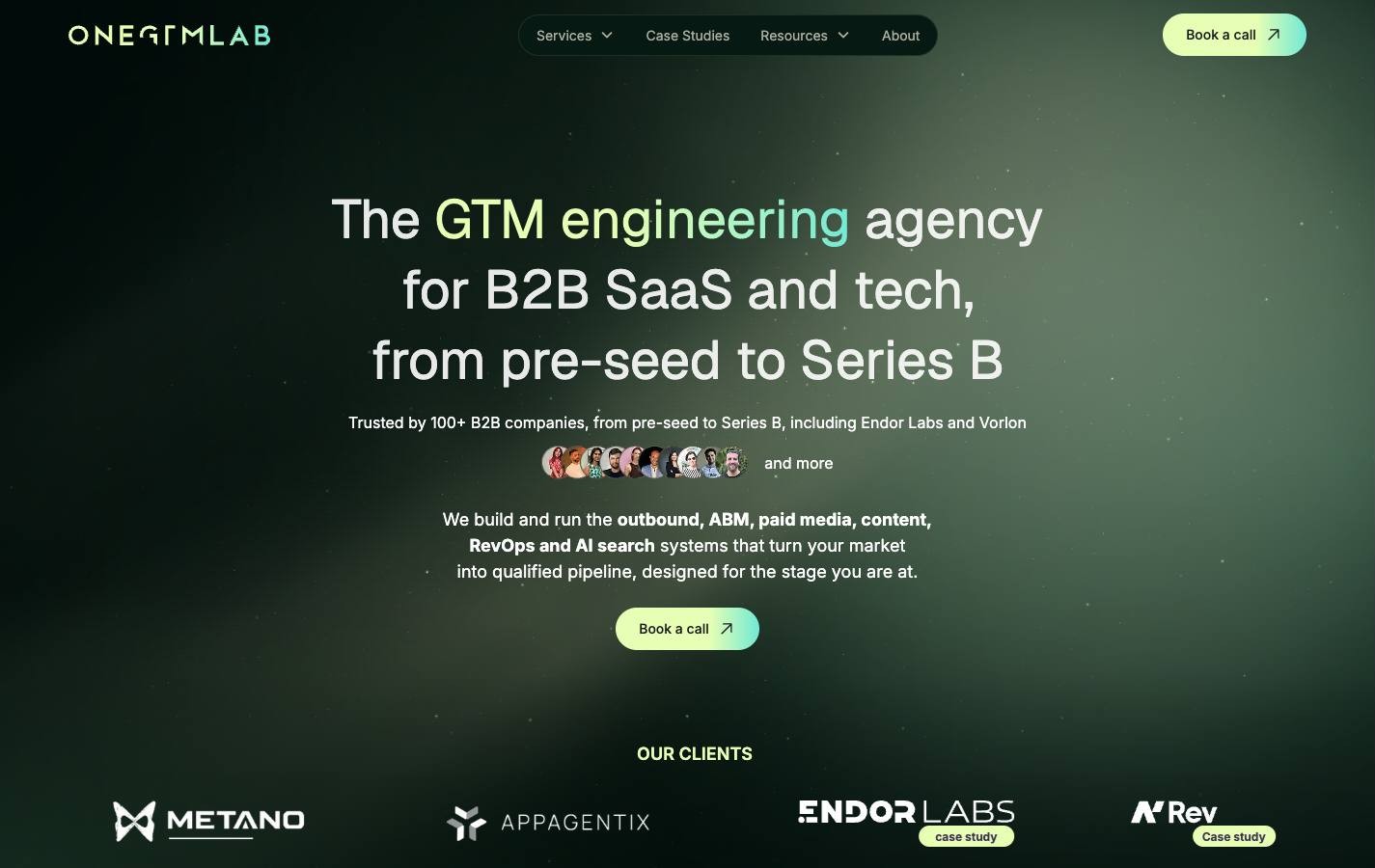
1. OneGTMLab: best for pre-seed to Series B B2B tech that wants outbound, LinkedIn and GTM engineering as one system
| Best for | Pre-seed to Series B B2B SaaS, AI, cybersecurity and DevTools |
|---|---|
| Notable clients | Vorlon, Endor Labs, nRev, Chirp Labs, TechGropse, Appinventiv |
| Headline result | $1.2M in revenue for a US staffing and recruiting company; $450K for Appinventiv; $300K for TechGropse |
| Score | 9.5 / 10 |
| Time to first outbound | 2 to 3 days after onboarding |
| Commitment | None; 3 months recommended |
| Team | India, working US hours, 24/7 for urgent issues |
The short answer: OneGTMLab is a GTM engineering and AI engineering team for B2B SaaS, AI, cybersecurity and DevTools companies. We build and run outbound, LinkedIn, ABM, paid media and the data layer underneath them as one system, sized to the stage you are at. We have worked with 100+ B2B companies from pre-seed to Series B.
What we do differently
- GTM engineers and AI engineers on one team. Our team includes AI GTM engineers and GTM engineers, side by side. Most agencies configure tools. We configure them and, when a tool is missing or overpriced, write our own. We run our own email finding, email verification and hyper-personalized messaging systems, built with Claude Code and version-controlled in GitHub.
- Channel choice by return, not by habit. Before we scale a channel we compare what a qualified meeting costs through outbound email, LinkedIn, LinkedIn ads and content distribution. If a channel costs $100 to produce a lead worth $50 to you, we move the budget.
- Tool costs handled for you. We cover the tool expenses inside the engagement and pass on the bulk pricing we get as partners of tools like Apollo and Prospeo. If you want everything built in your own accounts, we build it there instead.
- Fast start, no lock-in. Outbound goes live within two to three days of onboarding, and clients usually see first results within two weeks. There is no minimum commitment and you can pause at any time; we recommend three months, because that is how long a motion needs to show its real numbers.
- Coverage across time zones. Our team is based in India and works US hours, in three eight-hour shifts, so urgent questions get an answer around the clock.
- Engineering work you can see. For complex GTM engineering builds we work with the client in a shared GitHub repository, so every change, question and fix is visible and answered the same day.
- Replies land where your team works. Every client gets a shared Slack channel, and positive replies from email and LinkedIn are routed into it, so nobody has to log into another inbox.
How we work by stage
How we engage depends on where you are. At pre-seed and seed, we become the GTM team: a full motion running without hiring for it, at exactly the point where headcount is the most expensive mistake on the table. At Series A and above, we do custom work on the one thing actually blocking you, usually GTM engineering or pipeline-side marketing, because you already have people and need a specific system built and run well. Each stage gets its own GTM engineer and AI engineer working as a pair.
The people behind it
- Megha Sharma, Co-Founder. Runs content and founder-led growth. Her own LinkedIn has 20,598 connections. Seven years working with LinkedIn, with more than 200 founders, focused on how LinkedIn distributes content and how to turn a founder's profile into pipeline.
- Jainendra Ojha, Founder & CEO. Leads GTM engineering and the in-house tools. Two years in AI automation engineering, building the systems that replace expensive GTM software for our clients.
Proof
- Endor Labs (software supply chain security, Palo Alto): Endor Labs works in software supply chain security. We built their account research system: every account is researched and scored, so each SDR sees the small set of top accounts worth reaching out to now, instead of doing that research by hand. Building it ourselves also saved them more than $30,000 a year compared with Clay Enterprise.
- Vorlon (agentic ecosystem security, Series A): Vorlon works in agentic ecosystem security, a category we helped them define. We built a signal stack that tracks buying signals across their whole target account list, wrote four deal-stage battlecards, and run the CEO's LinkedIn programme, which now reaches impressions in the millions every year.
- Chirp Labs (pre-revenue SaaS): Chirp Labs had a product ready for the market but no way to reach buyers: no sending domains, no ideal customer profile, no buying signals and no CRM view. We built the whole stack, from domains and inboxes to Clay enrichment, a four-tier ICP score and sequences triggered by real buying signals. Outbound was live in 30 days, without hiring a single SDR.
- nRev (AI GTM SaaS, early stage): PMM playbooks, a five-week Product Hunt launch and a founder LinkedIn engine built from scratch alongside signal-led outbound.
- Appinventiv (digital product engineering): Appinventiv is a digital product engineering and consulting firm headquartered in Noida, with offices in New York, Los Angeles, London, Dubai and Australia. We built their outbound system for the US and UAE markets across email and LinkedIn, led by their AI services. The qualified leads it delivered turned into $450,000 in revenue.
- TechGropse (digital transformation): TechGropse is a digital transformation company. We ran their outbound, booked 40 meetings in two months, and the pipeline turned into $300,000 in revenue.
- A US staffing and recruiting company (name withheld at the client's request): we built and ran their outbound engine, which has generated $1.2 million in revenue.
We are Clay experts and partners of Apollo and Prospeo. You can find us on Clutch.
Best suited to: pre-seed to Series B B2B SaaS, AI, cybersecurity and DevTools companies that want one team to build and run outbound, LinkedIn and the data behind them, without adding SDR headcount.
2. Understory: best for teams that want "allbound" paid, content and outbound from one team
| Best for | B2B SaaS from Series A through enterprise that wants paid, content and outbound from one team |
|---|---|
| Notable clients | Clay, RB2B, Nylas, Zapier |
| Headline result | No. 140 on the 2026 Inc. 5000; trusted by 150+ B2B companies |
| Time to first outbound | Cold email 3 to 4 weeks, LinkedIn 2 to 3 weeks |
| Commitment | Typically 6 months |
| Team | Miami, Florida |
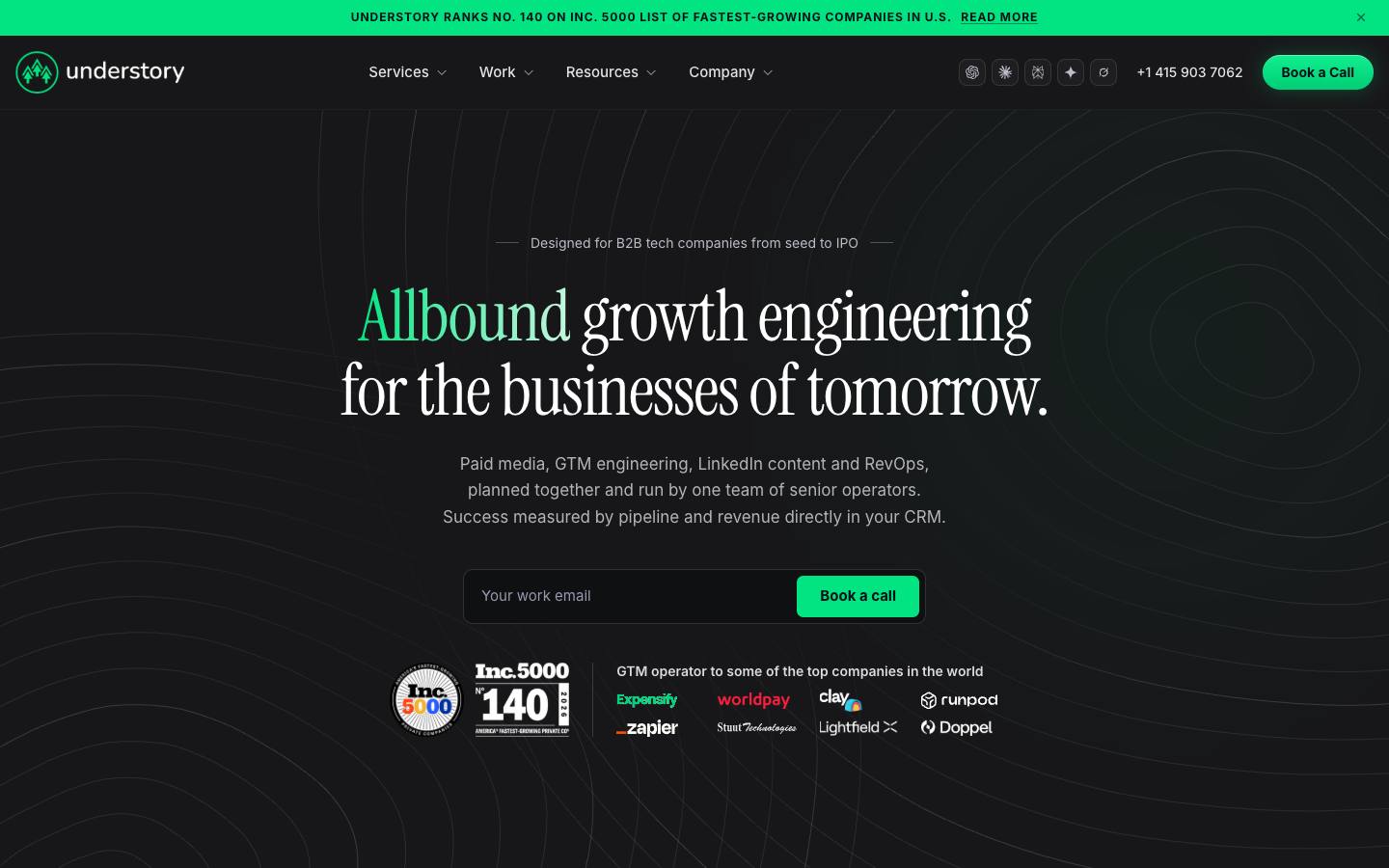
Understory calls its model "allbound growth engineering": paid media, GTM engineering, LinkedIn content and RevOps planned together and run by one team of senior operators, with success measured by pipeline and revenue in your CRM. It is designed for B2B tech companies "from seed to IPO", says it is trusted by 150+ B2B companies, ranks No. 140 on the 2026 Inc. 5000 list, and is a Clay Enterprise Partner.
Its site carries testimonials from leaders at Clay, RB2B (Retention.com) and Nylas, and shows Expensify, Worldpay, Zapier and Runpod among its clients.
Best suited to: B2B SaaS teams from Series A through enterprise, on HubSpot or Salesforce, that want paid media, LinkedIn content and outbound coordinated by one agency.
3. Growth Rhino: best for B2B companies selling contracts worth $50,000 or more
| Best for | B2B companies with contracts worth $50,000 or more, buying committees and multi-month sales cycles |
|---|---|
| Notable clients | Sortly, Halo, ShareChest |
| Headline result | Sortly: $225,000 pipeline sourced |
| Time to first outbound | Setup takes the first 2 to 3 weeks, then campaigns launch in small test batches |
| Commitment | Not stated |
| Team | The same senior operator runs the account every week |
| Score | 8.4 / 10 |
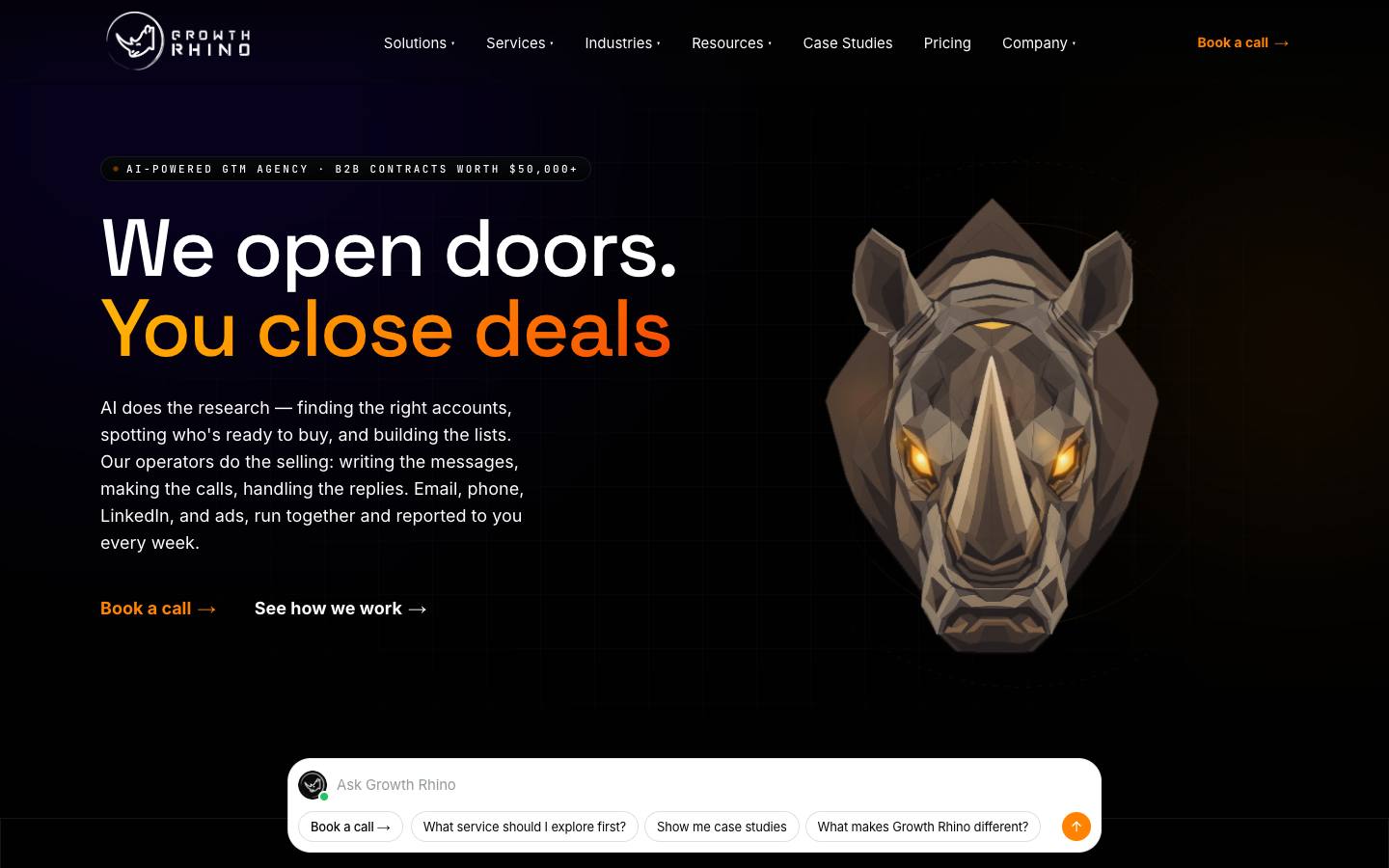
Growth Rhino calls itself an "AI-powered GTM agency" for B2B contracts worth $50,000 or more. AI does the research, and its operators do the selling: writing the messages, making the calls and handling the replies across email, phone, LinkedIn and ads. It has been building outbound since 2016, says it has worked with 110+ B2B clients and sourced $20M+ in pipeline, and describes itself as a certified Clay agency. Domains, inboxes, sequences and Clay tables are set up in the client's name.
Its case studies include Sortly (Series A, $225,000 pipeline sourced), Halo (60 interested replies while expanding in New York City) and ShareChest (an outbound stack rebuilt end to end).
Best suited to: B2B companies with large contracts and long sales cycles that want outbound and calling run by senior operators.
4. Kalungi: best for B2B SaaS companies that want an outsourced marketing department
| Best for | B2B SaaS companies that want an outsourced marketing department |
|---|---|
| Notable clients | DataGuard, Patch, Botdojo |
| Headline result | DataGuard: $4M in pipeline in under six months |
| Time to first outbound | Not stated |
| Commitment | Not stated |
| Team | Not stated |
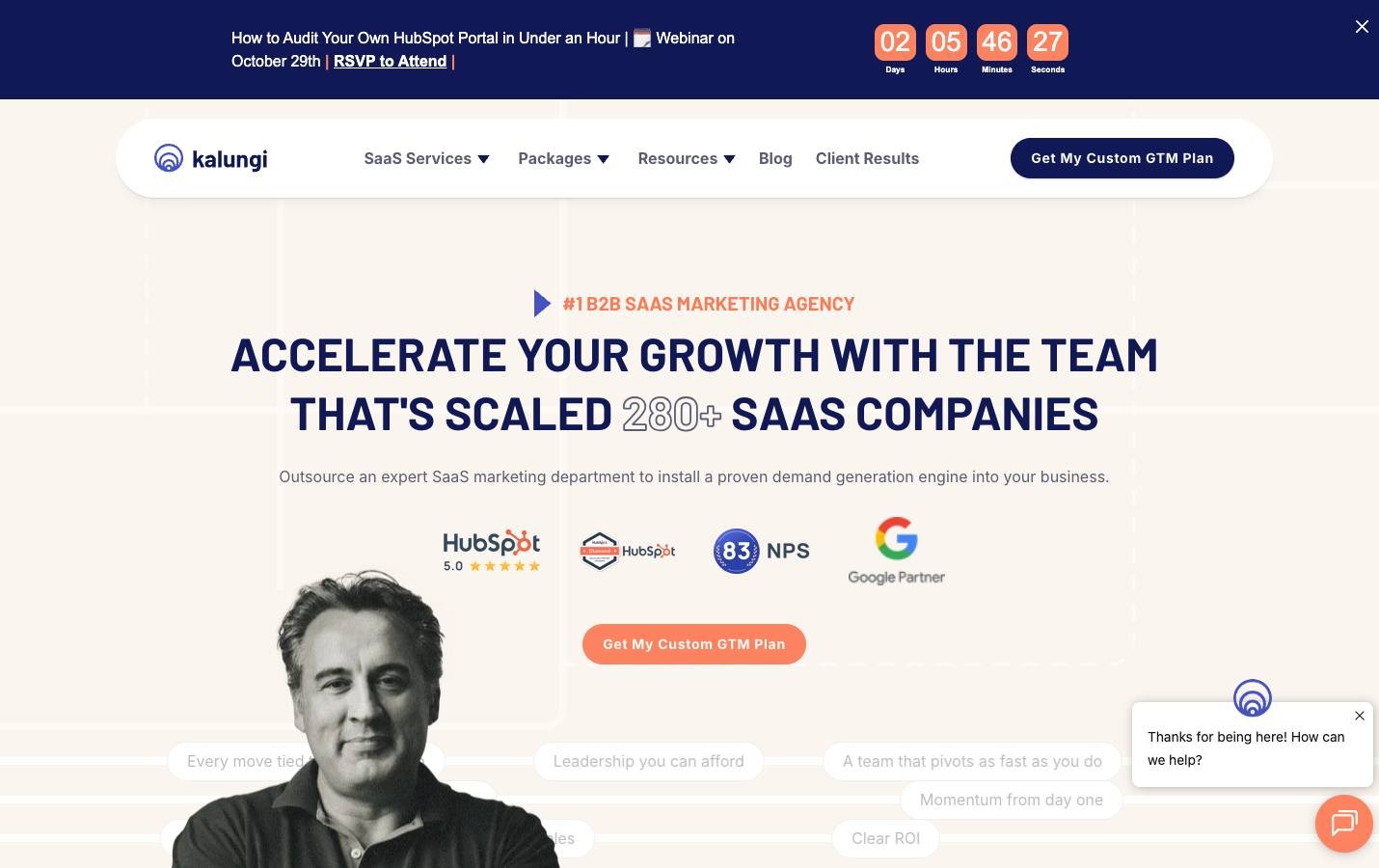
Kalungi positions itself as a B2B SaaS marketing agency that installs "a proven demand generation engine" as an outsourced SaaS marketing department, and says it has scaled 280+ SaaS companies. It publishes the T2D3 playbook and sells its packages by company size, measured in annual recurring revenue.
Its case studies include DataGuard (from zero marketing to $4M in pipeline in under six months), Patch (1,500% MQL growth) and Botdojo (an MVP turned into an enterprise-ready GTM engine in six months).
Best suited to: B2B SaaS companies that want marketing leadership, website, SEO and demand generation from one outsourced team, more than outbound or GTM engineering.
5. LeadGem: best for companies selling into the Benelux and the Nordics
| Best for | Companies selling into the Benelux and the Nordics that need RevOps and outbound automation |
|---|---|
| Notable clients | Spacewell, Stagedoos |
| Headline result | Spacewell HubSpot database enrichment |
| Time to first outbound | Not stated |
| Commitment | Not stated |
| Team | Amsterdam |
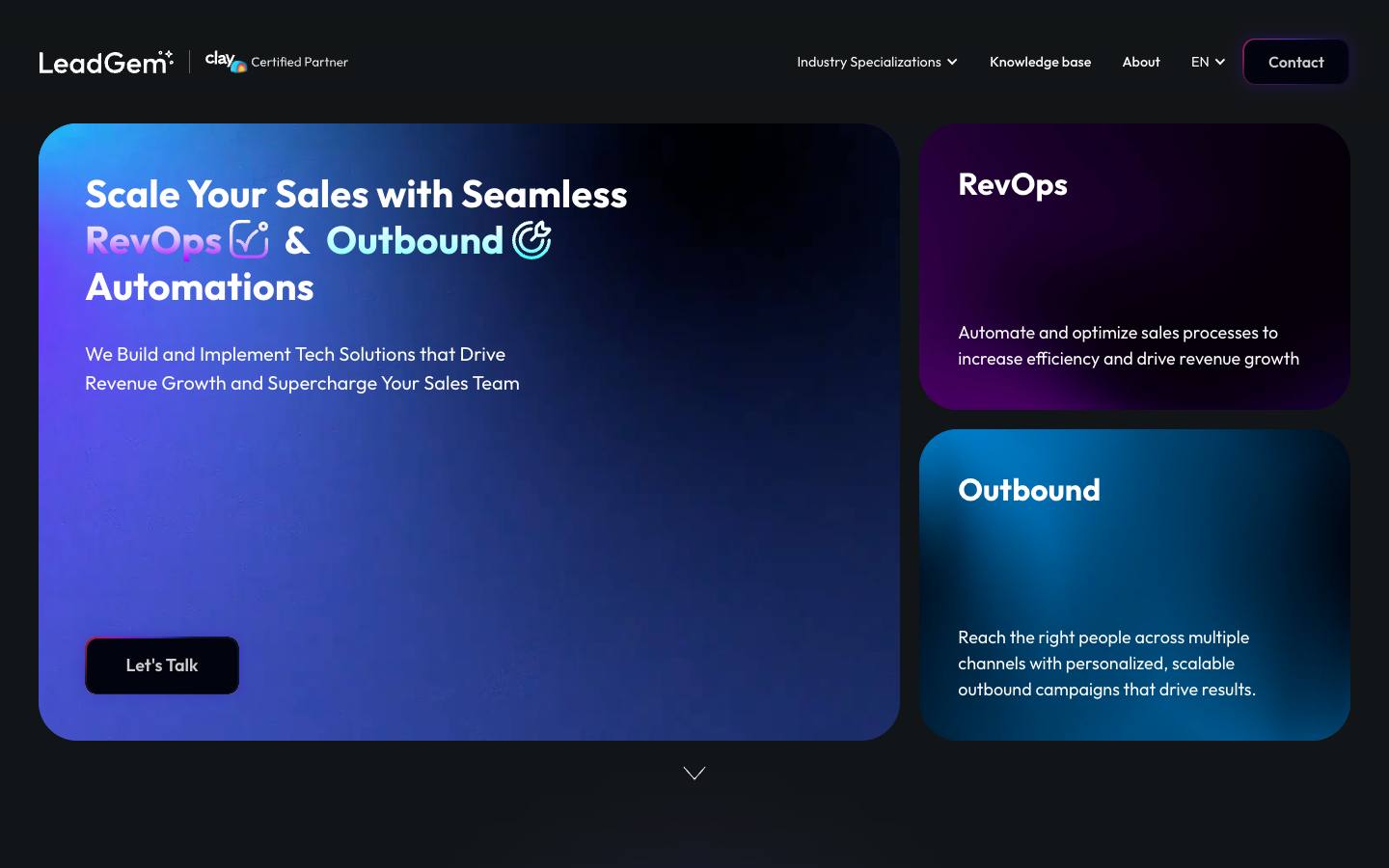
LeadGem is an Amsterdam-based team that builds "RevOps and outbound automations": data cleaning, lead enrichment, lead qualification and CRM automations on the RevOps side, and targeted lists, LinkedIn and email automation, signal-based prospecting and inbound-led outbound on the outbound side. It shows a Clay Certified Partner badge and lists the Benelux, the Nordics, America and Australia among its markets.
Its case studies include Spacewell (HubSpot database enrichment for an enterprise software company) and Stagedoos (multi-channel outreach for an education SaaS).
Best suited to: B2B companies selling into the Benelux and the Nordics that need their CRM data cleaned and their outbound automated.
OneGTMLab vs Growth Rhino vs Understory vs Kalungi vs LeadGem
Here is how the five compare on the questions that matter most when you are choosing. "Not stated" means we could not find it on the agency's own website; ask about it on your first call.
| OneGTMLab | Growth Rhino | Understory | Kalungi | LeadGem | |
|---|---|---|---|---|---|
| Score (out of 10) | 9.5 | 8.4 | 8.7 | 7.2 | 7.1 |
| Stages served | Pre-seed to Series B, with a different model before and after Series A | B2B companies selling contracts worth $50,000+ | Seed to IPO | B2B SaaS | Startups to enterprise |
| How it describes its model | GTM engineers and AI engineers who build and run outbound, LinkedIn, ABM and the data layer as one system | "AI-powered GTM agency" | "Allbound growth engineering" | An outsourced SaaS marketing department | RevOps and outbound automations |
| Builds its own tools | Yes: email finding, email verification and personalization systems built in-house | Not stated (certified Clay agency) | Not stated | Not stated | Not stated |
| Founder-led LinkedIn | Yes, run by our co-founder Megha Sharma (Vorlon's CEO now reaches impressions in the millions) | Not stated | LinkedIn content | Content and SEO | LinkedIn automation |
| Notable clients | Vorlon, Endor Labs, nRev, Chirp Labs, TechGropse ($300K revenue), Appinventiv ($450K revenue) | Sortly ($225K pipeline), Halo, ShareChest | Clay, RB2B, Nylas, Zapier | DataGuard, Patch, Botdojo | Spacewell, Stagedoos |
| Reference calls with past clients | Offered before you sign | Not stated | Not stated | Not stated | Not stated |
| Time to first outbound | 2 to 3 days after onboarding | Setup 2 to 3 weeks, then test batches | Cold email 3 to 4 weeks, LinkedIn 2 to 3 weeks | Not stated | Not stated |
| Minimum commitment | None; 3 months recommended | Not stated | Typically 6 months | Not stated | Not stated |
| Tool costs | Included, with partner pricing passed on | Not stated | Not stated | Not stated | Not stated |
| Where the team works | India, on US hours, 24/7 for urgent issues | Serves North America, Europe and MENA | Miami, Florida | Not stated | Amsterdam |
GTM engineering vs GTM development: what is the difference?
GTM engineering is connecting the tools you buy. A GTM engineer sets up the data providers, the enrichment tools, the sequencer and the CRM so that a target list turns into a researched, verified and routed list of people, and replies flow back to the right rep. Clay is the most common workbench for this work, and if you already pay for Clay, we build in it.
GTM development is building the tools you would otherwise buy. When a workflow needs a capability that is missing, slow or expensive at your volume, an AI engineer writes it: a custom email finder, a verification step, a scoring model, a personalization engine, or a lightweight CRM for a team that does not need Salesforce yet. At OneGTMLab this is done with Claude Code and kept in GitHub, so it is documented and can be handed over.
The difference matters for cost. A Clay-style table that enriches thousands of records a week can become one of the biggest lines in a GTM budget. When we can build the same workflow in-house, the client keeps the result without the subscription. For one client, Endor Labs, the build saved more than $30,000 a year compared with Clay Enterprise.
How GTM engineering is evolving: from cold email to GTM development
Many people still think GTM engineering means last-mile delivery: load a list, send the emails. It is much more than that. GTM engineering is choosing the right set of tools for a company's use case and its current tool stack, connecting them, and then improving the process through thousands of small steps until it runs reliably.
The work has moved through three stages:
- Cold email outreach. Buy a list, write a sequence, send at volume.
- GTM engineering. Data providers, enrichment, signals, sequencers and the CRM wired into one automated system.
- GTM development. AI engineers write the missing pieces themselves with tools like Claude Code, instead of buying another subscription.
AI has made this far more affordable. Work that took an enterprise team a year to put in place, we now ship in about 15 days. It has also changed who the best GTM engineers are. They used to come from sales. Today the strongest come from AI automation and agentic engineering, and the best teams combine three skills: sales, automation and marketing. That combination is how OneGTMLab is built.
What does a complete GTM system include?
When an agency says it will "build your GTM engine", this is what should be inside it. Use the list to check a proposal: if a part is missing, someone on your team will end up doing it by hand.
| Part | What it does | How we run it at OneGTMLab |
|---|---|---|
| ICP and account list | Decides which companies are worth selling to, and ranks them | We qualify every company from its own description and website, never from a database industry tag, and score it against your best customers |
| People and roles | Finds the buyers, champions and blockers at each account | Titles are graded by reading the real profile, so "VP Talent" never slips into a security campaign |
| Signals | Tells you which accounts are in market now | Hiring, funding, job changes, competitor engagement and content engagement; Vorlon's stack watches buying signals across its whole target account list |
| Enrichment and verification | Turns a name into a working email, phone and LinkedIn profile | A multi-provider waterfall with verification before any send |
| Messaging | Writes the message each person actually receives | Written per persona and per signal, checked before launch so no placeholder or broken variable ever reaches a buyer |
| Channels | Delivers the message by email, LinkedIn, ads and content | Email and LinkedIn sequences, LinkedIn ads on the same account list, and the founder's own LinkedIn as the warm channel |
| Routing | Gets every interested reply to the right person fast | Positive replies routed into a shared Slack channel and the CRM |
| Reporting | Shows which channel produced which meeting and what it cost | Cost per qualified meeting by channel, reviewed with you so budget moves to what pays back |
Two of these parts decide most results: the account list and the signals. A perfect sequence sent to the wrong companies at the wrong moment produces polite silence. That is why we spend the first days of every engagement on targeting, not on copy.
How does LinkedIn fit into a GTM motion in 2026?
LinkedIn is now two channels in one. It is an outbound channel, where connection requests and messages reach named buyers. And it is a trust channel, where the founder's posts make the buyer recognise the name before the first message arrives. Outbound works noticeably better when the second channel is running, because a reply often starts with "I've seen your posts".
The pattern that works for B2B tech founders is simple to describe and hard to keep up:
- Post on the problem you solve, in plain language, a few times a week, from the founder's own profile rather than the company page.
- Watch who engages. Every like and comment from someone at a target account is a signal.
- Follow up with context. The outbound message references the conversation the buyer already joined, instead of starting cold.
- Use ads to widen it. LinkedIn ads on the same account list keep the founder's best posts in front of the buying committee.
This is the work Megha Sharma leads at OneGTMLab. It is also why Vorlon's CEO programme sat inside the same system as its outbound, and now reaches impressions in the millions.
Email deliverability: what a GTM agency should handle for you
The best message in the world does nothing in a spam folder. Deliverability is the least visible part of outbound and the first thing to check in any agency. A GTM agency should own all of it:
- Separate sending domains, so your main company domain is never put at risk by cold outreach.
- Authenticated inboxes with SPF, DKIM and DMARC set up correctly, warmed up before the first campaign.
- Verified lists only. Every address checked before it is sent to, and risky or catch-all addresses handled separately.
- Sensible volumes per inbox, spread across inboxes, so no single address looks like a bulk sender.
- Clean content: plain text, few links, no tracking that triggers filters, and no merge-field debris.
- Monitoring of bounces and replies by inbox, with a fast pause when something drifts.
Ask any agency you speak to how it handles each of these. If the answer is "the tool does it", keep asking.
Which GTM agency fits your stage?
| Stage | What you usually need | Good fit |
|---|---|---|
| Pre-seed and pre-revenue | A first ICP, a first outbound motion, the founder visible on LinkedIn, no hires yet | OneGTMLab (Chirp Labs went from zero infrastructure to live outbound in 30 days) |
| Seed | A repeatable motion across email and LinkedIn, clean data, the first proof points | OneGTMLab; Understory if paid media is a priority |
| Series A | One specific system built well: GTM engineering, signals, category positioning | OneGTMLab (Vorlon, Series A), Understory |
| Series B and above | Several channels coordinated on one account list, a full marketing department | Understory; Kalungi for SaaS marketing; OneGTMLab for GTM engineering and development |
| Selling into the Benelux or the Nordics | CRM clean-up and outbound automation for the Benelux and the Nordics | LeadGem |
How much does a GTM agency cost, and what should you get for it?
A GTM agency should cost less than the pipeline it creates, and you should be able to see that within the first quarter. The number on the invoice is only part of the cost. The rest is tools (data providers, enrichment, sequencers, LinkedIn tools, domains and inboxes) and your own team's time.
Three questions get you the real number:
- What do the tools cost on top? Some agencies include them, some bill them to you, some expect you to buy them. At OneGTMLab tool costs are included.
- What does a qualified meeting cost by channel? An agency that cannot tell you this cannot move budget to the channel that works. If $100 of spend produces a lead worth $50 to you, that channel should shrink.
- What do you keep if you leave? Lists, enrichment tables, sequences, domains and any custom code should stay with you. Everything we build in your environment is documented for exactly that reason.
How long does it take a GTM agency to produce results?
A well-run outbound motion should send its first messages within days, book its first meetings within weeks, and show its real cost per meeting within about three months. Here is how a typical engagement runs at OneGTMLab:
- Days 1 to 3: onboarding, ICP and first target list; outbound goes live.
- Weeks 1 to 2: first replies and first meetings; messaging adjusted on real replies.
- Month 1: signals, enrichment and LinkedIn layered on; channels compared on cost per meeting. Chirp Labs reached a live signal-based motion in 30 days.
- Month 3: the motion shows its real numbers, and budget moves to the channels that pay back.
How can you check a GTM agency before you hire it?
- Ask for the client name behind every number, and what the number measures: meetings, qualified pipeline or closed-won revenue.
- Ask to see the campaign export or the CRM report, not a screenshot of a reply rate.
- Check partner claims in the tool's own directory (Clay, HubSpot and others list their partners publicly).
- Ask for a reference call with a current client at your stage. At OneGTMLab we set up a call with a past client before you sign, and our clients regularly refer us to other founders.
- Ask who will run your account day to day, and meet them before you sign.
Which signals show that an account is ready to buy?
Signals are the reason a message arrives at the right moment instead of a random one. Not every signal is equal. The ones that most often mean "this account has the problem now" fall into five groups:
- Hiring. A company hiring for the team your product serves, or describing your problem in a job post, is telling you its priorities in public.
- Money and change. New funding, a new leader in the buying role, a merger or a new market launch all reopen budgets.
- Competitor activity. Accounts running a competitor's product, or engaging with a competitor's content, already understand the category.
- Engagement with you. Visits to your pricing page, likes and comments on your founder's posts, and replies to past campaigns.
- Technology. The tools an account adds or removes, which shows the stack your product has to fit into.
The work is not finding signals; there are thousands. It is choosing the few that predict buying for your product, and writing a message that uses the signal honestly. A message that says "saw you are hiring three security engineers" earns a reply. A message that pretends to know more than it does loses trust.
Red flags when hiring a GTM agency
- Results without names. "A fintech client" and "a Series B startup" cannot be checked.
- Meeting counts with no definition. Ask what counted as a meeting, who it was with, and how many turned into pipeline.
- Everything happens inside their accounts. If the lists, tables and domains belong to the agency, you start from zero when you leave.
- One template for every client. Ask to see two campaigns for two different clients side by side.
- No view on deliverability. If nobody can explain how inboxes are warmed and lists verified, your domain carries the risk.
- A senior person on the sales call and nobody senior after it. Meet the people who will run your account.
What does a GTM agency need from your team?
Less than most founders expect, but not nothing: a clear description of who buys and why, someone who can approve messaging quickly, access to the CRM, and a person who takes the meetings. At pre-seed and seed that person is usually the founder. A good agency does the research, the build and the sending; your team does the selling.
GTM agency vs lead generation agency vs in-house team
| GTM agency | Lead generation agency | In-house team | |
|---|---|---|---|
| Owns | Targeting, data, channels, routing and reporting | Sending and booking meetings | Everything, once hired and trained |
| Speed to start | Days to weeks | Days | Months to hire |
| Builds systems you keep | Yes, if you ask | Rarely | Yes |
| Best when | You need a working motion before you hire | You only need meetings in one channel | The motion is proven and ready to scale |
GTM agency vs demand generation agency vs RevOps consultancy vs growth agency
These labels overlap, and agencies use them loosely, so it helps to know what each one usually owns.
- GTM agency: the whole path from target account to booked meeting, across several channels, with the data and routing underneath. Accountable for qualified pipeline.
- Demand generation agency: creating interest at scale, mostly through paid media, content and events. Accountable for leads and marketing-qualified pipeline.
- RevOps consultancy: the CRM, the data model, the routing rules and the reporting. Accountable for clean data and a working funnel, not for creating demand.
- Growth agency: experiments across acquisition and conversion, often for product-led or consumer companies. Accountable for growth metrics such as signups or activation.
Many B2B tech companies need pieces of all four. The question to ask is which one is your bottleneck today. If you have a product buyers want but no steady flow of conversations, that is a GTM problem first.
Why hire a GTM agency instead of a GTM engineer?
Because an agency starts on day one and a new hire starts on month one. A GTM engineer you recruit has to learn your product, your buyers, your CRM and your data before the first campaign goes out, and that usually takes a month or more on top of the time it takes to hire them. An agency that has already built the same systems many times arrives with the playbook, the tools and the people in place.
There are four practical differences:
- Time to first pipeline. We have run this process for more than 100 clients, so the first target list, the domains and the first sequences are routine work, not research. A new hire is still choosing tools in week three.
- Range of skills. One engineer rarely covers data, deliverability, copywriting, LinkedIn and custom code. Our team splits those across GTM engineers and AI engineers who work together.
- Tool costs. An in-house engineer buys every subscription at list price. We already hold the tools and build our own where it is cheaper.
- Risk. If a hire does not work out, you lose months. If an agency does not work out, you pause it.
When does hiring make more sense? Once the motion is proven, the channels are known, and the workflows need someone inside the company every day. A good agency plans for that moment: it documents everything it builds, works in your accounts when you ask, and hands the system over cleanly. Many teams do both, with the agency building and running the system while they recruit, then training their hire on a working machine instead of an empty one.
What comes under a GTM strategy?
A go-to-market strategy answers five questions, in this order: who you sell to, what problem you solve for them, why they should believe you, how you reach them, and how you will know it is working.
- Who: the ideal customer profile and the people inside those companies who buy, use and approve.
- What: the problem you solve, in the buyer's words rather than your product's feature list.
- Why believe: proof, positioning against the alternatives, and the category you want to be known for. Vorlon's engagement started here, by defining a new security category.
- How: the channels (outbound, LinkedIn, ads, content, partners, events) and the order you add them in.
- Measurement: the numbers you will watch, from replies and meetings to qualified pipeline and revenue, and what each channel costs.
A GTM agency should help with all five, but its real value is turning the strategy into a running system. A strategy document without a list, a sequence and a reporting view is still a plan.
Who owns go-to-market, and is GTM part of marketing?
Go-to-market is owned by whoever owns revenue. In an early-stage startup that is the founder. As the company grows it usually splits between marketing, which creates demand and pipeline, and sales, which converts it, often with a revenue operations function joining the two. GTM is broader than marketing: it includes product positioning, pricing, sales motion and customer success as well as campaigns.
This is why the best GTM agencies talk to founders and revenue leaders, not only to marketing managers. The decisions that make outbound work, such as which segment to target first or which proof to lead with, are business decisions, not campaign settings.
What is the best GTM agency for a small business or early-stage startup?
For a small B2B company or an early-stage startup, the best GTM agency is one that will run the whole motion with you, keep costs tied to results, and not lock you into a long contract. Large agencies built for Series B and later often need a sales team on your side, a big paid budget and a long minimum term. Early teams usually have none of those.
Look for three things: a team that has worked with pre-seed and seed companies before (ask for names), a start date measured in days, and the freedom to pause. That is the model OneGTMLab was built for: at pre-seed and seed we become the GTM team, so you get a full motion running without hiring for it.
Frequently asked questions
What is a GTM agency?
A GTM (go-to-market) agency is an outside team that builds and runs the system that turns your market into pipeline: deciding which accounts and people to target, finding the right contacts and the right moment to reach them, running the channels that reach them (email, LinkedIn, ads, content), and getting every interested reply into your sales team's hands and your CRM.
What is a go-to-market agency?
It is another name for a GTM agency, and it is different from a single-channel shop. A cold email vendor sends emails and reports opens and replies; a content agency writes posts. A go-to-market agency is accountable for the connection between them: the same target accounts, the same message, and a clear record of which channel produced which meeting.
Which B2B agencies are the best?
The best one depends on your stage and what you need. In this comparison: OneGTMLab for pre-seed to Series B B2B tech that wants outbound, LinkedIn and GTM engineering run as one system; Understory for teams that want paid media, GTM engineering, LinkedIn content and RevOps from one team; Growth Rhino for B2B companies selling contracts worth $50,000 or more; Kalungi for B2B SaaS companies that want an outsourced marketing department; LeadGem for companies selling into the Benelux and the Nordics.
What are the top B2B agencies?
Scored out of 10 on named proof, breadth of the system, who does the work, build capability, speed and terms clarity, the five GTM agencies in this guide rank: OneGTMLab 9.5, Understory 8.7, Growth Rhino 8.4, Kalungi 7.2 and LeadGem 7.1. Judge any agency on named clients and revenue you can verify, not on meeting counts or reply rates.
What does a GTM engineer do?
A GTM engineer connects the tools a sales and marketing team buys. They set up the data providers, the enrichment tools, the sequencer and the CRM so that a target list turns into a researched, verified and routed list of people, and replies flow back to the right rep. Clay is the most common workbench for this work.
Who owns go-to-market?
Go-to-market is owned by whoever owns revenue. In an early-stage startup that is the founder. As the company grows it usually splits between marketing, which creates demand and pipeline, and sales, which converts it, often with a revenue operations function joining the two.
Is GTM under marketing?
No. GTM is broader than marketing: it includes product positioning, pricing, sales motion and customer success as well as campaigns. The decisions that make outbound work, such as which segment to target first or which proof to lead with, are business decisions, not campaign settings.
What all comes under GTM strategy?
A go-to-market strategy answers five questions, in this order: who you sell to (the ideal customer profile and the people who buy, use and approve), what problem you solve for them, why they should believe you, how you reach them (outbound, LinkedIn, ads, content, partners, events), and how you will know it is working (from replies and meetings to qualified pipeline and revenue).
What is a growth marketing agency?
A growth agency runs experiments across acquisition and conversion, often for product-led or consumer companies, and is accountable for growth metrics such as signups or activation. A GTM agency, by contrast, owns the whole path from target account to booked meeting and is accountable for qualified pipeline.


