
GTM Engineering

We Don’t Say Yes To Every Client

Jainendra Ojha
7 mins
Last Updated on
September 13, 2026
Table of content
COMMUNITY
Join the ONEGTM CLUB
500+ GTM leaders and operators discussing what's actually working — in real time.
About the author
Jainendra Ojha
Co-Founder @ OneGTMLab
Engineered a unified GTM and automation system for scalable growth.

A field guide to the 7 red flags I used to ignore, and what each one cost me.

Every consultant has a client story that still makes them wince. Mine usually start the same way. A great first call. A founder who "gets it." A deal that closes fast because nobody pushed back.

That speed should have been the warning.

So, here’s who I don't take anymore, and why I learned it the expensive way.
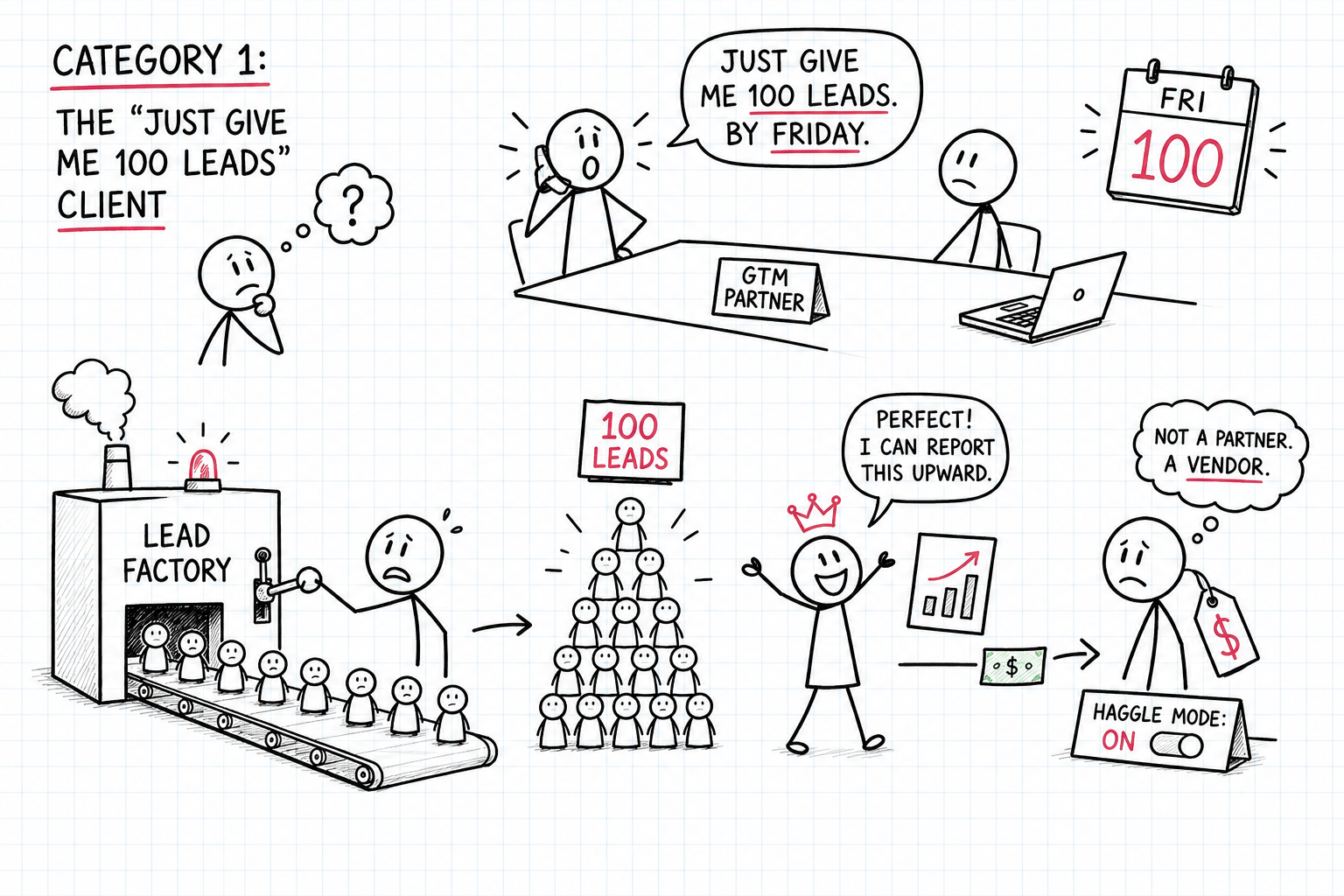
Category 1: The "Just give me 100 leads" Client

They don't want a system. They want a number by Friday.

I once onboarded someone who didn't want pipeline. He wanted a headcount he could report upward. The moment you agree to a lead number, you've stopped being a GTM partner and become a vendor he'll haggle with every month. And he will haggle.
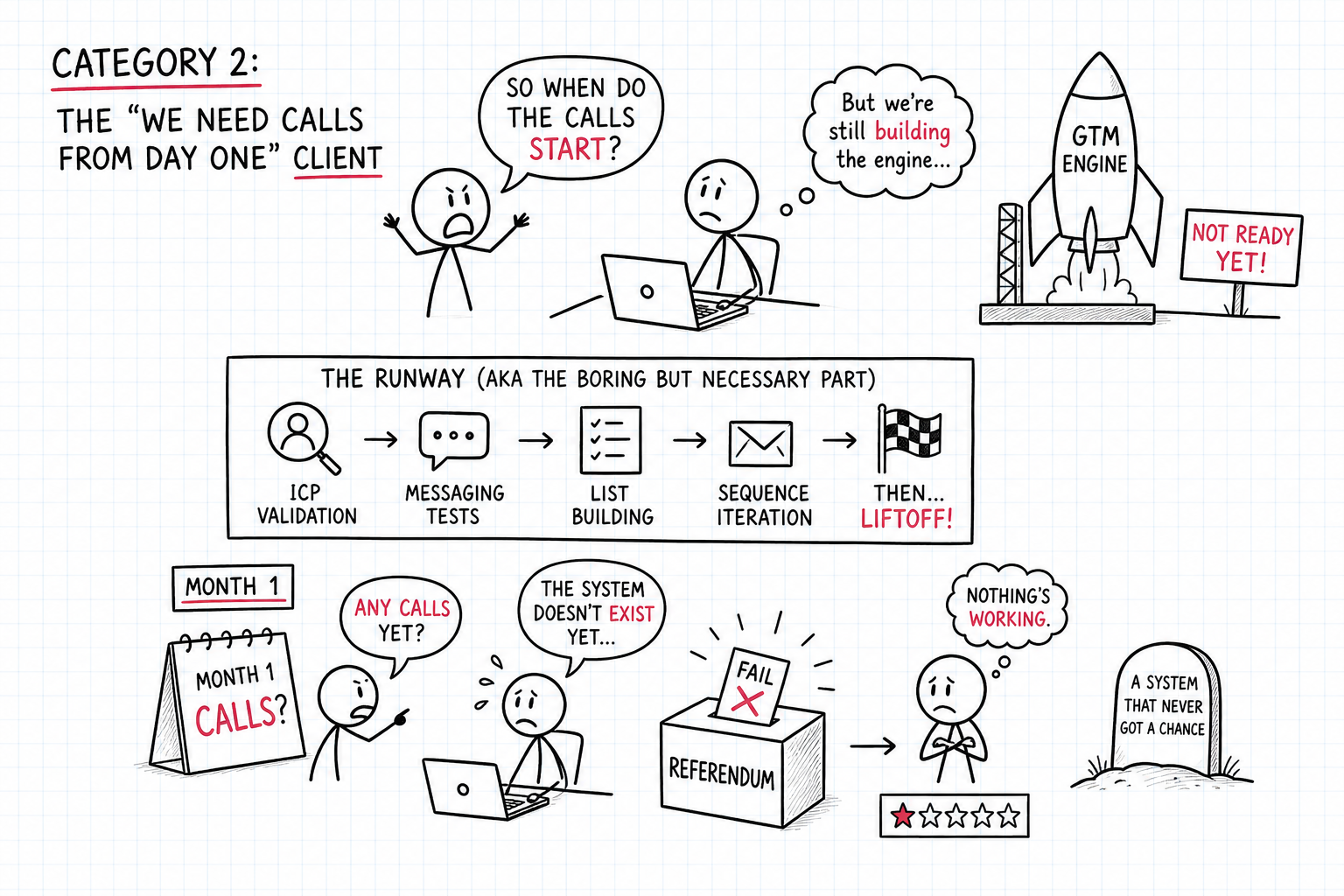
Category 2: The "we need calls from day one" Client

Zero patience for the part where the system actually gets built.

Every real GTM engine has a runway before liftoff. ICP validation, messaging tests, list building, sequence iteration. I onboarded a client once who skipped straight to "so when do the calls start." Month one became a referendum on a system that hadn't been given a chance to exist yet.
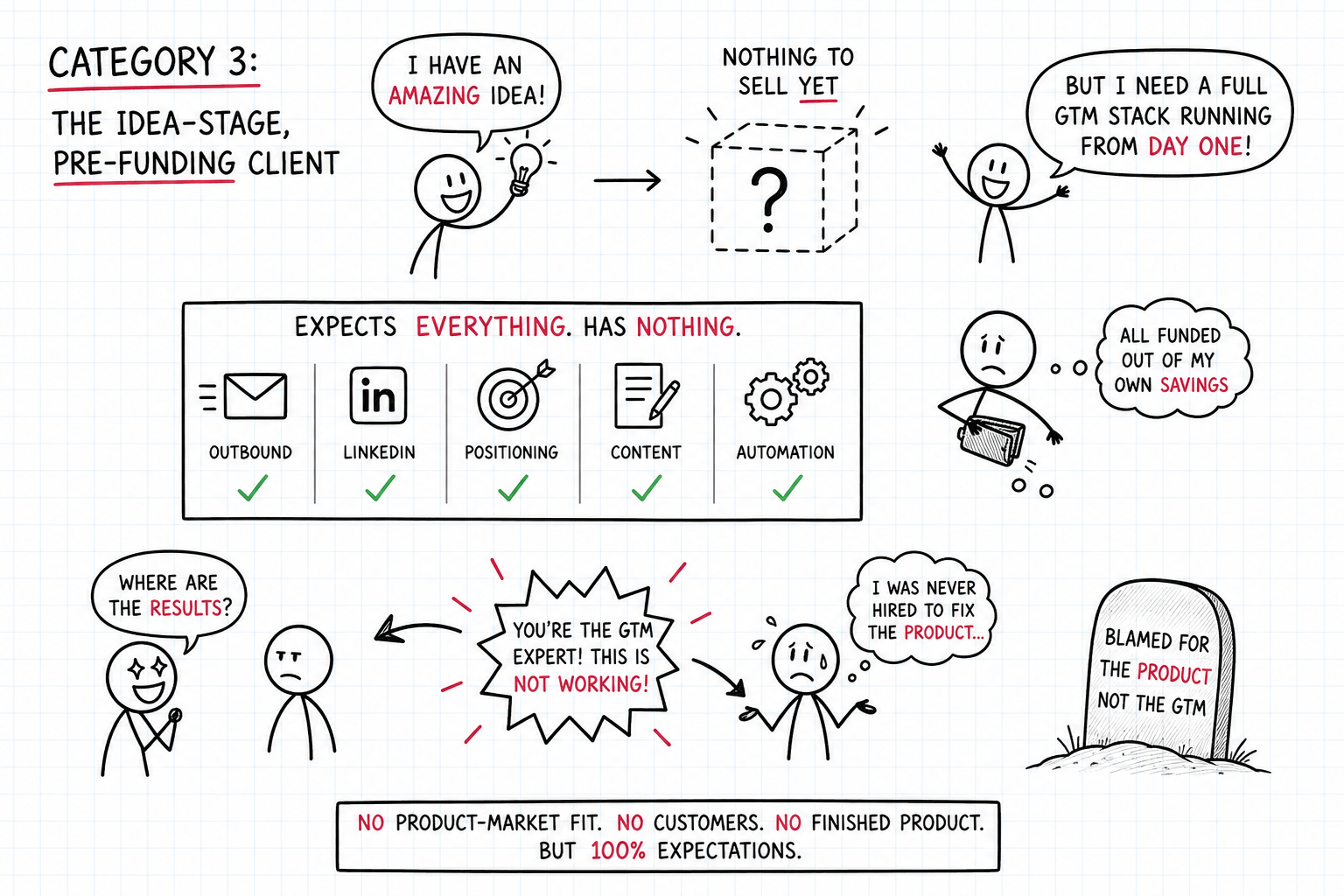
Category 3: The idea-stage pre-funding client

Nothing to sell yet, but a full GTM stack expected anyway.

No product-market fit. No customer base to learn from. Sometimes no finished product. I've had someone at this stage want outbound, LinkedIn, positioning, all running in parallel, funded out of his own savings. You will get blamed for the thing you were never hired to fix: the product itself.
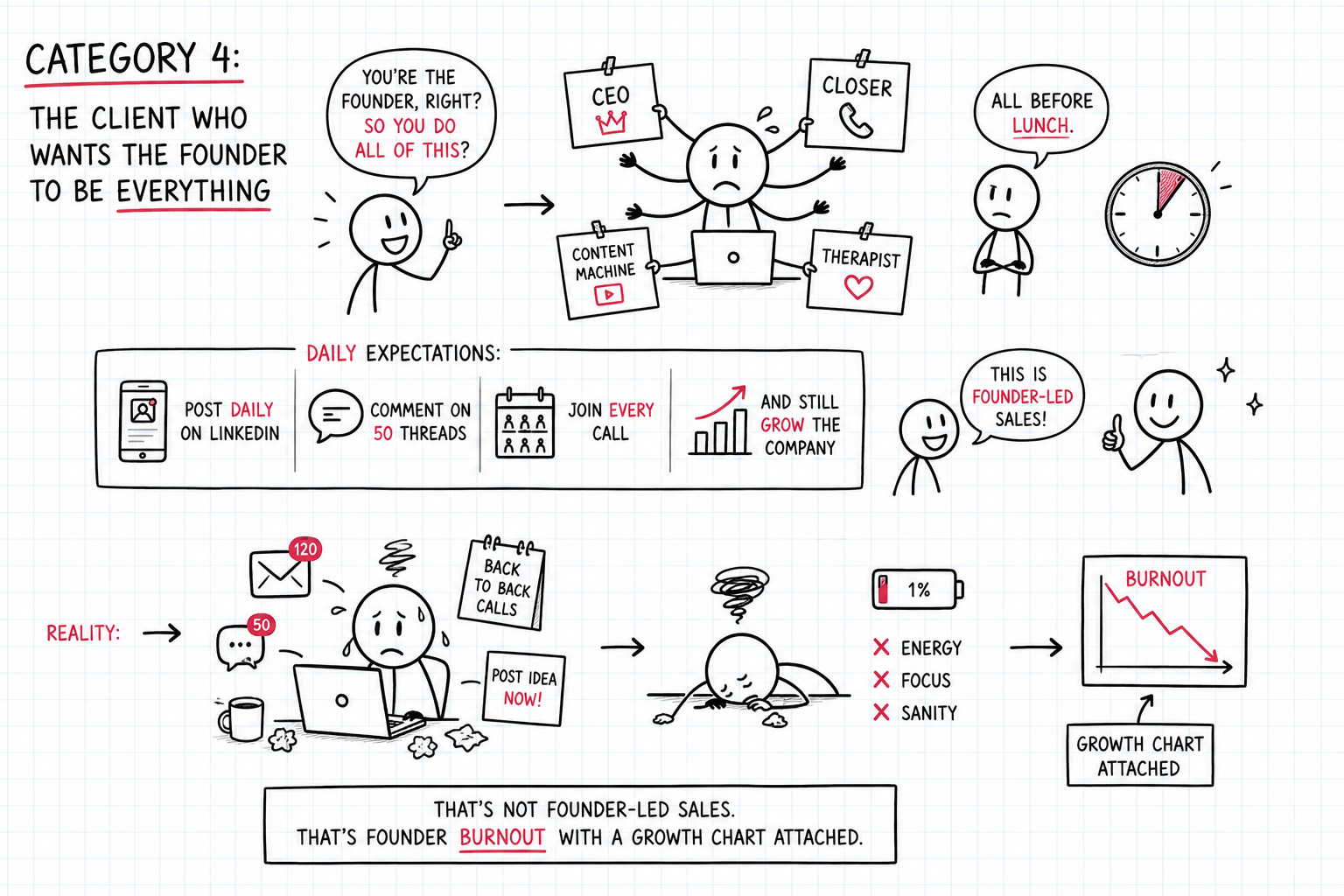
Category 4: The client who wants the founder to be everything

CEO, closer, content machine, and therapist. All before lunch.

Some engagements quietly expect the founder to post daily, comment on fifty threads, join every call, and somehow still run the company. That's not founder-led sales. That's founder burnout with a growth chart attached.
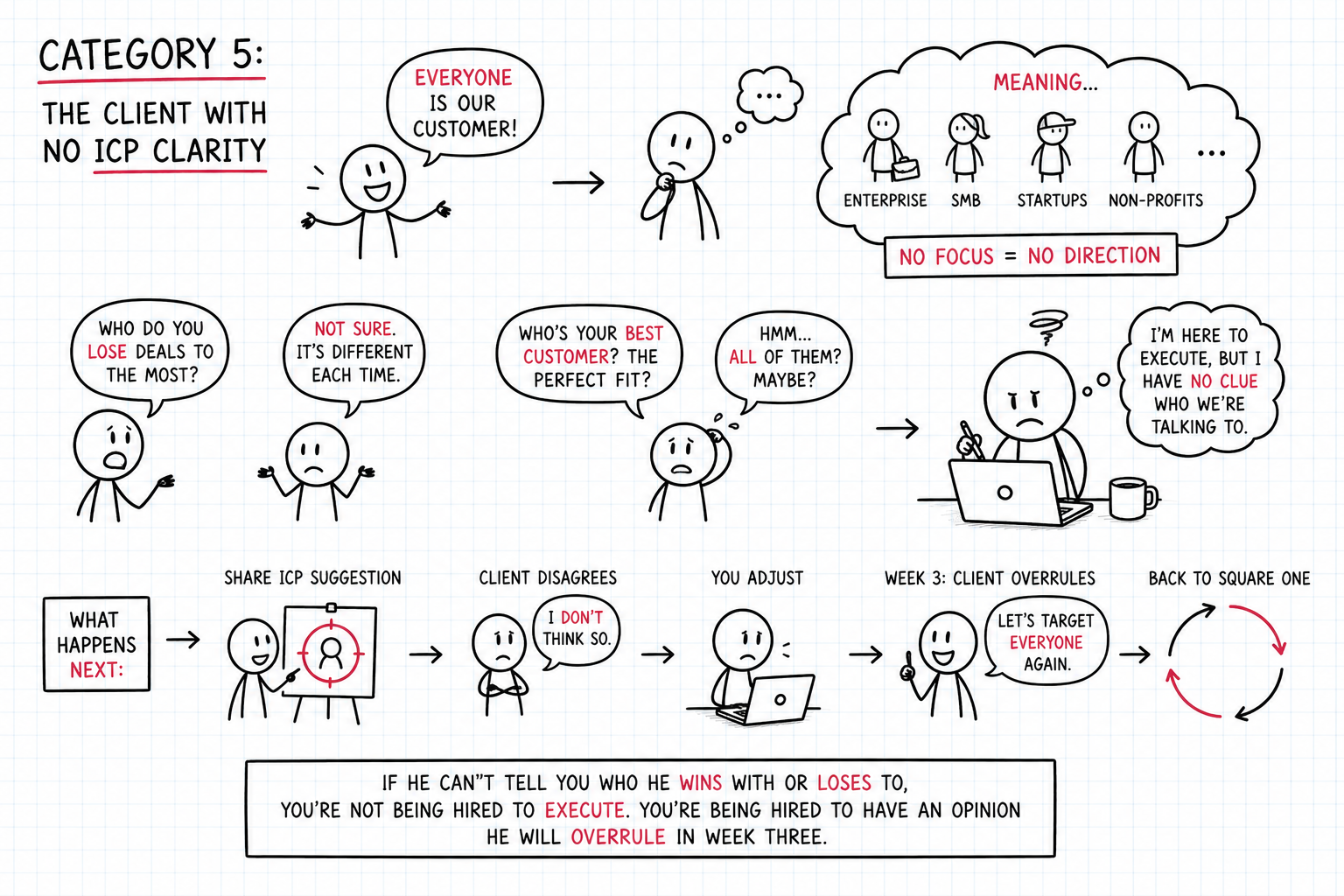
Category 5: The client with no ICP clarity

"Everyone is our customer" is not a strategy. It's a confession.

If a founder can't tell you who he loses deals to, or who his best customer actually looks like, you are not being hired to execute a GTM motion. You are being hired to have an opinion he will overrule in week three.
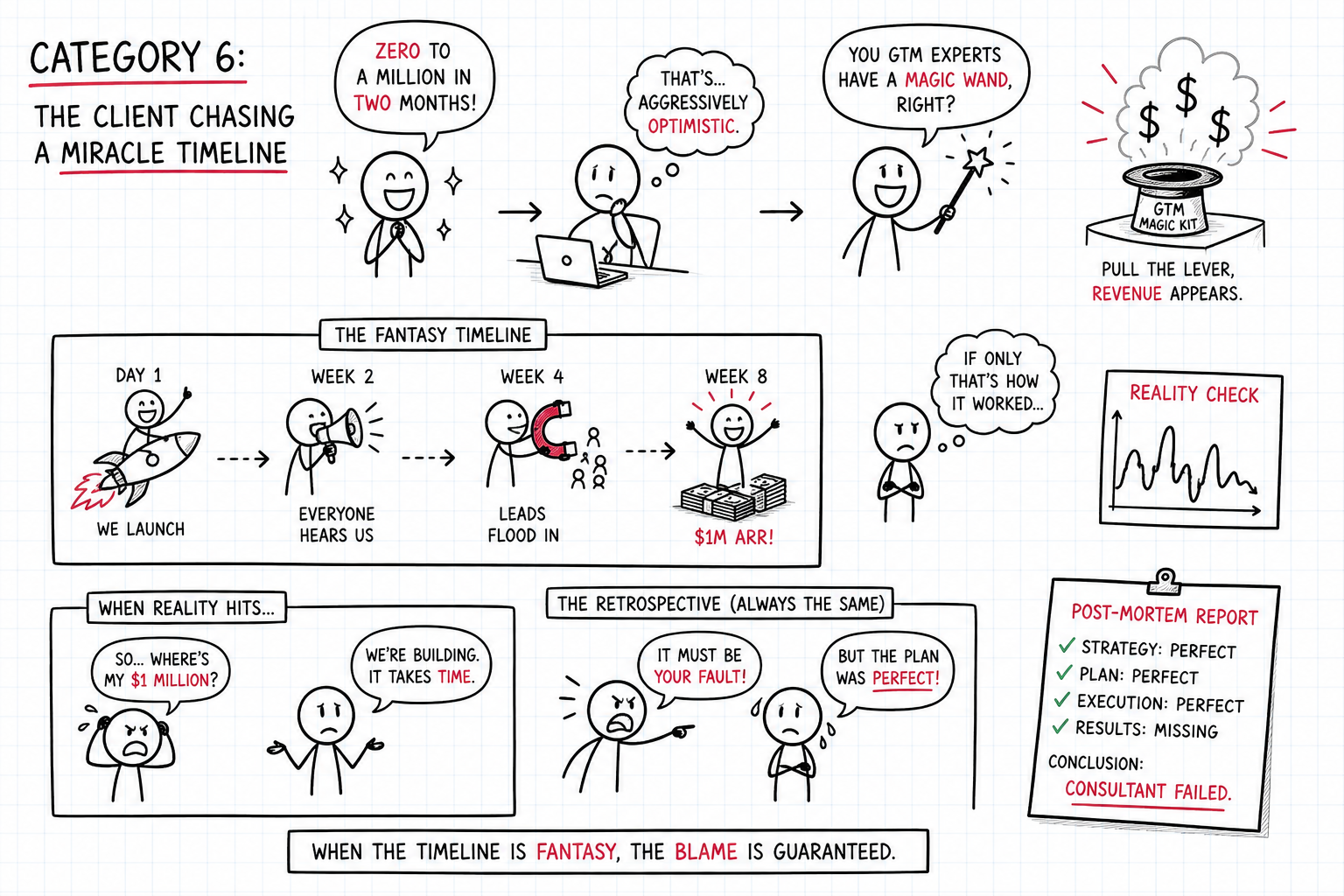
Category 6: The client chasing a miracle timeline

Zero to a million in two months, because apparently we own a magic wand.

I once had a client convinced that GTM consultants keep a secret lever somewhere. Pull it, revenue appears. When the timeline is fantasy, the retrospective is always the same: it must be your fault, because the plan was flawless.
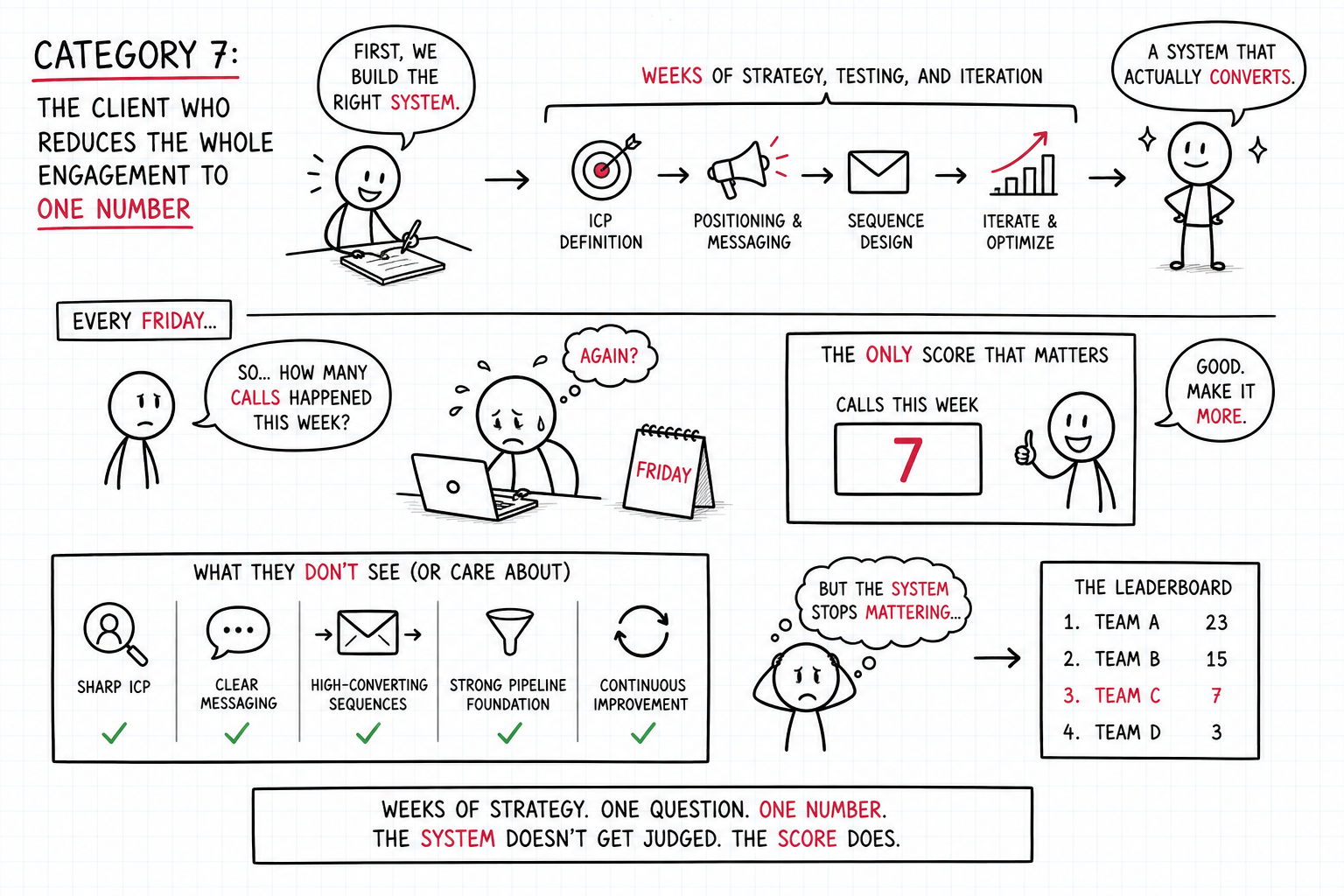
Category 7: The client who reduces the whole engagement to one number

Weeks of positioning work, collapsed into "how many calls happened this week."

You can build the sharpest ICP, the cleanest messaging, a sequence that actually converts, and it still gets flattened into one question every Friday. The system stops mattering. Only the leaderboard does.

And the one I say out loud on every discovery call now

We are not your SDR team. We never will be.

We build the system. We don't sit in a chair and dial all day. If the expectation is a warm body doing outreach at agency day rates, that's a different vendor, and a different conversation.

Every one of these clients looked fine on the first call. That's the actual lesson here, not the checklist. The people worth working with reveal themselves in what they ask for in week one, not in how well they pitch themselves in the first thirty minutes.

So here's the real question I've started asking before any proposal goes out.

What is this founder optimizing for: a system, or a number he can screenshot?
Frequently Ask Questions: Quick Answers to the Real Questions

Is the MQL dead?
No, but it has been demoted by the people who invented it. Forrester’s model now tracks buying groups rather than individual qualified leads. It still works as an internal routing mechanism. It is a poor metric to report upward, which is a different question.
What is a sales accepted lead, and do we need one?
An SAL is a lead sales has agreed to contact, sitting between MQL and SQL. It separates lead quality from follow-up discipline. You need it if marketing and sales are arguing about whose fault the drop-off is. Otherwise it is a stage that adds admin.
What is a good MQL to SQL conversion rate?
Not honestly answerable with a number, which is uncomfortable but true. The rate depends entirely on where you set your MQL threshold. Lower the bar and volume rises while conversion falls. The useful measure is whether your own rate is stable, and what changed when it moved.
Who should own the MQL definition, marketing or sales?
Neither alone. Owned by marketing it drifts toward volume, owned by sales it drifts toward a bar so high marketing stops trying. Set it jointly, review it on a schedule, and make the sales acceptance rate the number both sides are judged on.
How often should these definitions be reviewed?
Quarterly, and any time pricing, product or sales headcount changes materially. The threshold reflects sales capacity, so a team that doubles headcount and keeps the old bar is leaving conversations on the table.
Do these terms still work for product-led growth?
Poorly, because the model assumes qualification happens before use. In PLG someone has signed up and used the product before anyone qualifies anything. PLG teams usually replace the MQL with a product qualified lead, scored on usage depth and account spread rather than content engagement.
About the author
Jainendra Ojha
Co-Founder @ OneGTMLab
Engineered a unified GTM and automation system for scalable growth.

Frequently Asked Questions

What is GTM Engineering?

Traditional marketing runs campaigns. GTM Engineering builds the infrastructure that makes campaigns measurable, repeatable, and scalable.

How is it different from traditional marketing?

Traditional marketing runs campaigns. GTM Engineering builds the infrastructure that makes campaigns measurable, repeatable, and scalable.

Who needs GTM Engineering?

Traditional marketing runs campaigns. GTM Engineering builds the infrastructure that makes campaigns measurable, repeatable, and scalable.

What problems does it solve?

Traditional marketing runs campaigns. GTM Engineering builds the infrastructure that makes campaigns measurable, repeatable, and scalable.

What tools are typically involved?

Traditional marketing runs campaigns. GTM Engineering builds the infrastructure that makes campaigns measurable, repeatable, and scalable.

Subscribe To ONEGTMLAB Weekly

Your weekly dose of GTM sanity. Frameworks, signals, and strategies that actually move revenue.
Thank you! Your submission has been received!
Oops! Something went wrong while submitting the form.